The Evolution of Platform Engineering: Embracing the Agentic Enterprise with AI Integration.

Posted on July 21, 2026, the world of enterprise software stands at the precipice of its next major transformation, driven by the increasing sophistication of artificial intelligence. Platform engineering, a discipline born from the complexities of the cloud-native era, is undergoing a profound evolution. What began as a strategic response to the operational burden on development teams is now expanding its scope to serve not only human engineers but also intelligent AI agents, heralding the advent of the "Agentic Enterprise." This shift necessitates a re-evaluation of how platforms are constructed, what they manage, and who their primary consumers are, fundamentally redefining the operational foundation of modern businesses.
The Genesis of Platform Engineering: Taming Cloud-Native Complexity
The journey to the Agentic Enterprise is best understood by tracing the trajectory of platform engineering itself. A decade ago, organizations rapidly adopted cloud-native paradigms, embracing Kubernetes, microservices architectures, GitOps principles, and distributed systems. While these technologies promised unprecedented agility and scalability, they introduced a staggering degree of operational complexity. Each development team found itself grappling with an ever-growing list of responsibilities: provisioning infrastructure, configuring networking, implementing robust security protocols, establishing observability pipelines, ensuring regulatory compliance, and mastering a plethora of operational tools. The expectation for every developer to become a full-stack expert across development and operations proved unsustainable, leading to bottlenecks, inconsistent practices, and increased cognitive load.
Internal Developer Platforms (IDPs) emerged as the antidote to this complexity. Spearheaded by dedicated platform engineering teams, IDPs provided a curated, self-service experience for developers. They encapsulated organizational best practices, standardized environments, and established "golden paths" for software delivery. By abstracting away much of the underlying infrastructure and operational intricacies, IDPs allowed developers to concentrate on their core mission: delivering business functionality. These platforms evolved rapidly, integrating continuous delivery pipelines, GitOps workflows, comprehensive observability, automated policy enforcement, robust governance frameworks, and a superior developer experience into a cohesive operational model. Industry reports, such as those from Gartner and Forrester, have consistently highlighted the significant impact of IDPs on developer productivity, often citing reductions in lead time for changes by as much as 30-50% and a marked decrease in operational incidents. The global market for developer platforms and tools has seen robust growth, projected to exceed $100 billion by 2027, underscoring the critical role these platforms play in enterprise IT.
From Human-Centric to Hybrid Operations: The Rise of AI Agents
The foundational assumption underpinning the success of early IDPs was that the primary consumer of the platform was a human developer. Human engineers utilized these platforms to provision environments, deploy applications, consume shared resources, and manage software lifecycles, with the platform effectively abstracting away the underlying infrastructure. However, the rapid advancements in artificial intelligence, particularly in large language models and autonomous agents, are now challenging this core assumption.
In the Agentic Enterprise, AI agents are increasingly becoming co-equal consumers of the platform alongside human engineers. These intelligent software entities are no longer passive tools but active participants in the software development and operations lifecycle. They are capable of autonomously provisioning infrastructure, deploying applications, investigating production incidents by analyzing telemetry data, invoking operational workflows, interacting with various enterprise resources, and automating tasks that previously demanded direct human intervention. This monumental shift implies that the platform’s mandate expands beyond merely serving developers to providing a unified operational environment for both human intelligence and intelligent software, ensuring that both operate under the same stringent governance, security, and compliance models.
Lakmal Warusawithana, a prominent figure from WSO2 and a key contributor to cloud-native discussions, articulates this shift as more than just exposing APIs to AI. He emphasizes that it fundamentally redefines the platform’s responsibilities. Instead of functioning solely as a developer platform, it transforms into a comprehensive operational foundation through which a diverse cohort—developers, platform engineers, Site Reliability Engineers (SREs), and AI agents—collaboratively build, operate, and continuously enhance enterprise software. This evolution introduces a new layer of complexity but also promises unprecedented levels of automation and efficiency.
Redefining the Enterprise Software Estate: Applications, Resources, and AI Agents as First-Class Entities
Historically, IDPs were built around a singular primary abstraction: the application. Infrastructure was considered the layer beneath it, CI/CD pipelines wrapped around it, observability systems monitored it, and security controls protected it. Every component and process ultimately served to simplify the delivery and operation of applications, which were seen as the quintessential software assets organizations created and managed.
The Agentic Enterprise, however, necessitates a broader definition of what constitutes a "first-class entity" within the platform. While applications remain central to delivering business value, they are no longer the sole focus.
- Applications: These continue to be the primary artifacts developed by engineering teams. They encapsulate business logic, expose APIs, process events, and drive core business capabilities. Their importance is undiminished, serving as the interface through which users and other systems interact with an organization’s services.
- Resources: Traditionally treated as mere infrastructure or external dependencies, resources are now elevated to first-class platform objects. This category includes a vast array of components: databases, messaging systems, object storage, AI models, third-party APIs, identity providers, secrets management systems, Kubernetes clusters, SaaS integrations, and various execution environments. Each resource now possesses its own lifecycle, clear ownership, specific governance policies, detailed operational history, unique security requirements, and a defined set of policies. Managing them as distinct, trackable entities provides a consistent and holistic view of the entire enterprise software estate.
- AI Agents: These represent a fundamentally new class of software actor. Unlike applications that implement direct business functionality, AI agents are designed to reason over context, invoke tools, collaborate with humans and other agents, and automate operational activities. They interact with both applications and resources—provisioning infrastructure, coordinating deployments, investigating incidents, enforcing policies, and continuously improving software systems. They are not merely consumers but active participants, capable of initiating actions and making decisions within predefined parameters.
The critical insight here is the intricate interdependency of these three entities. Applications consume resources to deliver their capabilities. AI agents, in turn, consume many of the same resources to understand, monitor, and operate the system. Furthermore, AI agents interact directly with applications, often invoking their APIs or capabilities, while applications themselves may leverage AI agents for specialized tasks. Resources, therefore, become the common foundation, the connective tissue that links applications and AI agents within the broader enterprise software ecosystem. For platform engineering, this implies a shift in focus: from managing isolated components to managing the complex relationships and dependencies between applications, resources, and AI agents. The platform must now comprehend not just individual entities but also how they interoperate, how changes ripple through the system, and how both human and AI actors can safely and effectively interact with them. This comprehensive view forms the bedrock for the next generation of platform engineering, one that manages the entire enterprise software estate rather than just its application layer.
Context as the Operational Nexus: Enabling Intelligent Automation
As enterprise software evolves into a sophisticated, interconnected mesh of applications, resources, and AI agents, the ability to understand the relationships between these assets becomes paramount. Platform engineering’s role expands beyond merely deploying software; it must now encompass a deep understanding of how software behaves, its internal dependencies, and how changes propagate across the entire system.
Traditional observability platforms already generate an immense volume of operational data—logs detailing events, metrics quantifying system behavior, traces illustrating request flows, and events capturing state changes. While invaluable, these signals are primarily descriptive. They tell us "what happened" but often fall short of explaining "why" or "how" one event relates to another. Experienced engineers instinctively bridge this gap by synthesizing information from disparate sources: deployment history, ownership details, system topology, inter-component dependencies, operational policies, records of past incidents, and institutional knowledge. They reason using rich context, not isolated data points.
AI agents require this same contextual capability. An agent tasked with investigating a failed deployment needs more than just error logs. It needs to understand which application initiated the deployment, its dependencies, recent configuration changes, the ownership of affected resources, applicable policies, whether similar incidents have occurred previously, and which remediation actions were successful in the past. Without this broader, interconnected context, even the most advanced AI model is limited to making inferences based on disconnected observations.
This is precisely why "context" is emerging as a first-class platform capability. Modern platforms must build and maintain a shared, comprehensive understanding of the entire enterprise software estate. This understanding must seamlessly link applications, resources, AI agents, deployments, ownership, policies, topology, operational history, and organizational knowledge into a coherent, queryable model. Instead of navigating fragmented dashboards and disparate APIs, every platform consumer—human or AI—operates from the same rich contextual representation of the system. This context-aware foundation allows the platform to expose knowledge through interfaces tailored to each consumer: human users via portals, CLIs, or dashboards; AI agents via standardized protocols like the Machine Communication Protocol (MCP). The interfaces may differ, but they all draw from the same underlying, consistent understanding of the platform and its managed entities.
Furthermore, this contextual foundation unlocks richer platform capabilities. Reusable "skills" can encapsulate common engineering tasks, callable by both humans and AI agents. Specialized "built-in agents" can focus on domains like site reliability, security posture management, compliance auditing, or FinOps optimization. Because these capabilities operate on a shared contextual model, they can collaborate seamlessly, avoiding the pitfalls of isolated, siloed automations. Ultimately, context transforms the platform from a mere workflow execution engine into an intelligent system that understands the software it operates, providing the essential foundation for collaborative development and continuous improvement of increasingly complex enterprise systems.
OpenChoreo: A Cloud-Native Blueprint for the Agentic Future
These forward-thinking concepts are not merely theoretical; they are already manifesting in modern cloud-native platforms. OpenChoreo, a CNCF Sandbox project, exemplifies a practical approach to evolving platform engineering for the Agentic Enterprise, all while remaining firmly rooted in established Kubernetes and cloud-native principles.
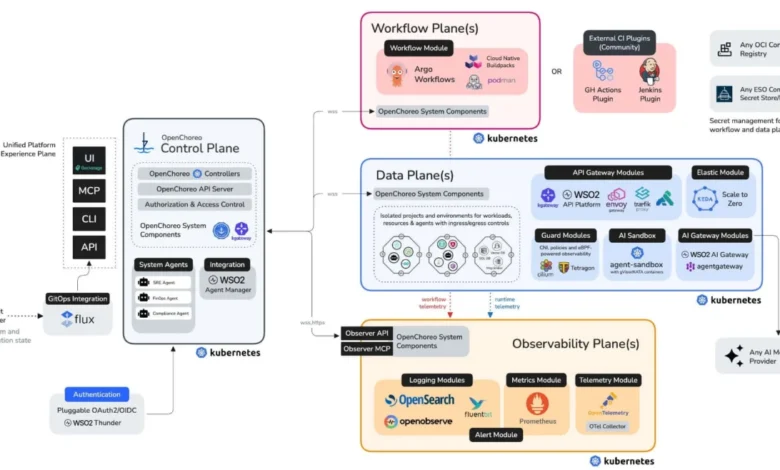
At its core, OpenChoreo continues to deliver the robust functionalities expected from a contemporary Internal Developer Platform. It empowers developers to build, deploy, secure, observe, and operate applications through familiar cloud-native methodologies such as CI/CD, GitOps, policy enforcement, and self-service capabilities. Crucially, Kubernetes remains the immutable system of record, ensuring that every platform abstraction accurately reflects the actual runtime state, thereby avoiding the introduction of an independent, potentially divergent, control plane.
What truly sets OpenChoreo apart is its dual-consumer design. It is meticulously engineered to serve both human users and AI agents. Developers, platform engineers, and SREs interact with the platform through their preferred interfaces—be it intuitive portals, powerful command-line interfaces, flexible APIs, or declarative GitOps workflows. Concurrently, AI agents access the identical platform capabilities via dedicated MCP servers. This architectural design ensures that despite varying interaction mechanisms, every consumer operates on the same unified platform, leveraging the same underlying understanding of applications, resources, their interrelationships, and the overall operational state.
OpenChoreo’s shared understanding begins with its treatment of applications and resources. Applications maintain their status as the primary software artifacts delivered by development teams. However, resources—including databases, messaging systems, object storage, APIs, AI models, secrets, identity providers, and external services—are explicitly modeled as first-class platform abstractions. Rather than relegating them to mere infrastructure details, OpenChoreo manages them as distinct objects, each with its own lifecycle, designated ownership, defined governance, and explicit relationships. This comprehensive modeling provides both humans and AI agents with a consistent and complete view of the enterprise software estate.
Further enhancing its adaptability, OpenChoreo boasts an extensible ecosystem architecture. Instead of embedding every conceivable capability into its core, new functionalities can be seamlessly introduced through "ecosystem modules." These modules can extend the platform with novel application capabilities, higher-level resource abstractions, deep enterprise integrations, diverse observability providers, specialized security services, new deployment targets, or domain-specific workflows. This modularity allows organizations to dynamically evolve and customize their platform without necessitating changes to its fundamental architecture.
This ecosystem approach naturally extends to AI capabilities. OpenChoreo supports "built-in agents" and reusable "skills" that enable organizations to automate common operational activities. Additional ecosystem modules can introduce advanced capabilities such as an Agent Manager for orchestrating AI agents, an AI Gateway for secure access, sandboxing environments for safe agent execution, sophisticated policy enforcement mechanisms, and robust evaluation frameworks. These features collectively enable AI agents to participate safely and effectively in platform operations, operating within the same governance, security, and observability frameworks as the rest of the platform. The modularity of OpenChoreo is arguably its most critical attribute, ensuring that as enterprise software continues its rapid evolution, new resource types, AI capabilities, operational patterns, and integrations can be added without redefining the platform’s core identity.
Industry Landscape and Broader Implications
The shift towards the Agentic Enterprise, exemplified by projects like OpenChoreo, is not an isolated trend but a crucial part of the broader digital transformation narrative. Analyst firms consistently project massive growth in AI adoption across enterprises. According to a recent IDC report, global spending on AI is expected to surpass $500 billion by 2027, with a significant portion allocated to AI-driven automation and operational intelligence. This influx of AI capabilities into the operational fabric of organizations necessitates platforms that can effectively manage and govern these new intelligent actors.
The implications for enterprise IT are multifaceted:
- Accelerated Innovation: By offloading repetitive operational tasks to AI agents, human developers and SREs can dedicate more time to innovation, complex problem-solving, and strategic initiatives.
- Enhanced Reliability and Efficiency: AI agents, with their ability to process vast amounts of data and execute tasks at machine speed, can proactively identify and remediate issues, leading to more resilient systems and reduced operational overhead.
- New Security and Governance Challenges: Integrating AI agents into critical operational workflows introduces new vectors for security risks and governance concerns. Platforms must provide robust identity management for agents, fine-grained access controls, clear audit trails, and policy enforcement mechanisms specifically designed for autonomous entities.
- Evolution of Roles: The role of platform engineers will expand to include designing and managing agent-platform interactions, defining agent capabilities, and ensuring the ethical and compliant operation of AI. Developers will increasingly interact with platforms that feature AI-assisted development and deployment.
- The Imperative of Open Standards: Projects under the Cloud Native Computing Foundation (CNCF) like OpenChoreo highlight the importance of open-source solutions and community-driven development in establishing the necessary standards and best practices for this evolving landscape. Open standards will be critical for interoperability and preventing vendor lock-in in the Agentic Enterprise.
Conclusion: The Future of Platform Engineering is Collaborative and Contextual
Platform engineering has consistently adapted to the changing tides of software development and operations. It began by streamlining infrastructure, matured into Internal Developer Platforms that standardized delivery, alleviated cognitive load, and fostered consistent operational practices. The Agentic Enterprise marks the next pivotal stage in this continuous evolution. Its defining characteristic is not merely the presence of AI agents but the emergence of a richer, more dynamic software ecosystem where applications, resources, and AI agents collaboratively pursue business outcomes. Applications remain the core value delivery mechanism. Resources are elevated to first-class software assets with their own lifecycles and governance. AI agents become intelligent, active participants, reasoning over context, automating workflows, and assisting both developers and platform engineers.
This evolution does not advocate for creating separate, siloed platforms for AI, nor does it diminish the enduring importance of applications. Instead, it expands the very definition and scope of platform engineering. Modern platforms must provide a unified operational model where applications, resources, and AI agents share common foundations for identity, governance, security, observability, policy enforcement, and lifecycle management. By managing these diverse software assets consistently and cohesively, organizations can fully embrace the transformative potential of AI without inadvertently introducing new operational silos or fragmented governance models.
The next generation of platform engineering will be measured not solely by its effectiveness in empowering human developers, but equally by its capability to holistically manage the complete enterprise software estate. Platforms that possess a deep understanding of the relationships between applications, resources, and AI agents, and that provide the essential context, robust governance, and inherent extensibility required to operate them synergistically, will form the foundational bedrock of the Agentic Enterprise. Ultimately, the future of platform engineering is not about building platforms for AI; it is about evolving the platform itself into the trusted, intelligent operational foundation where applications, resources, and AI agents can collaborate securely, consistently, and at enterprise scale, propelling organizations into an era of unprecedented automation and efficiency.